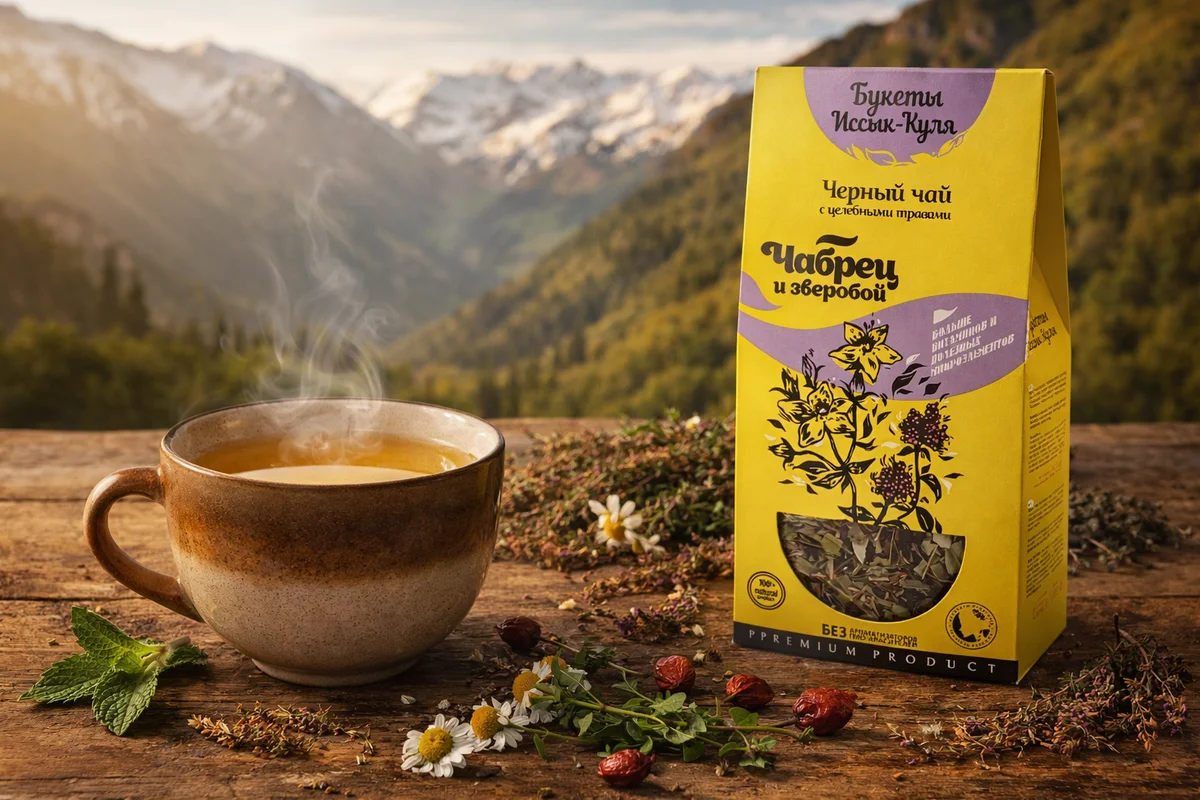
Mountain herbs are plants that grow at altitudes of 1,000 to 3,000 meters above sea level, where clean air, intense sunlight, and mineral-rich soil create ideal conditions for the accumulation of essential oils and beneficial substances. Issyk-Kul is one such place. The lake is surrounded by the Tien Shan mountain ranges, and dozens of species of mountain herbs grow on the slopes, from which "Issyk-Kul Bouquets" brand herbal teas are made.
Why Mountain Herbs Are Valued Higher Than Lowland Ones
At high altitudes, plants are exposed to intense ultraviolet radiation, temperature fluctuations, and winds. To survive in such conditions, they produce more protective substances — essential oils, flavonoids, and antioxidants. This is why mountain thyme is more aromatic than garden thyme, and mountain mint is more intense.
Another factor is ecology. There are no large industrial enterprises around Issyk-Kul. Herbs grow on clean, unpolluted slopes and are hand-harvested during peak flowering when the concentration of beneficial substances is at its highest.
Main Herbs in "Issyk-Kul Bouquets" Teas
Thyme. One of the most popular herbs in mountain teas. Contains essential oil, phenolic acids and flavonoids (Jalil et al., 2024). Thyme tea has a warm, spicy aroma and warms perfectly in cold weather.
Oregano. Contains essential oil and rosmarinic acid, the main phenolic compound of oregano (Nurzyńska-Wierdak, Walasek-Janusz, 2025). In tea, it gives a soft, warm, slightly sweet flavor.
Lemon Balm. The main compounds of its essential oil are geranial, neral and citronellal (Petrisor et al., 2022). Lemon balm tea has a pleasant citrus note and refreshing taste. Pairs well with green tea.
Peppermint. The main compounds of its essential oil are menthol and menthone (McKay, Blumberg, 2006). Mint tea is one of the most popular herbal beverages in the world. In mountain teas, mint is often combined with ginger for an additional warming effect.
Rosehip. One of the richest fruits in vitamin C — raw rose hips contain about 8 times more than oranges (USDA FoodData Central; orange data). Rosehip tea has a pleasant tart taste and beautiful ruby color.
St. John's Wort. Contains hypericin and hyperforin (Nobakht et al., 2022). In tea, it gives a tart, slightly bitter taste.
St. John's wort can interact with medicines, including birth control pills and antidepressants. If you take any medicines, are pregnant or breastfeeding, talk to your doctor before drinking tea with St. John's wort (NCCIH).
Chamomile. Contains flavonoids, including apigenin; the main compounds of its essential oil are bisabolol and chamazulene (Srivastava et al., 2010). Combined with cinnamon, it creates an unusual but harmonious flavor.
Fireweed (Ivan-tea). A traditional Russian and Central Asian beverage. Contains polyphenols — flavonoids and ellagitannins, including oenothein B (Schepetkin et al., 2016). Has a soft, slightly honey-like taste.
How to Properly Brew Herbal Tea
To get the maximum flavor and benefits from herbal tea, follow these rules:
- Water temperature: not boiling water, but 85–95°C. Pour water into the kettle, wait 1–2 minutes after boiling, then pour. Boiling water destroys some vitamins and essential oils.
- Steeping time: 5–7 minutes for leaf teas, 7–10 minutes for herbal teas with fruits (rosehip, hawthorn). Tea bags steep for 3–5 minutes.
- Teaware: glass or ceramic teapot works best. Metal can affect the taste.
- Proportions: 1 heaping teaspoon (or 1 tea bag) per 200 ml cup.
- Don't dilute with water: herbal tea is drunk as brewed, not like regular black tea which is brewed strong and diluted.
Herbal Teas in the Range
Besides black and green teas with mountain herbs, the brand makes herbal teas. With rosehip: "Immunity" (rosehip and ginger) and "Vitamin" (rosehip and mountain herbs); with mint, lemon balm and valerian: "Calming Blend." The range also includes "Relax," "Detox," "Liver Support," "Kidney Support," "Tonus," "Anti age" and others.
Full range — 36 types of tea in the "Tea" category of our catalog.
Mountain Tea as a Gift
"Issyk-Kul Bouquets" tea sets make an excellent gift. The "Unforgettable Kazakhstan" gift set by Ecofloris is designed in a souvenir style and contains mountain herbs of Kazakhstan. Tea duets "Jety-Oguz," "Barskaun," and "Karakol" are named after famous Issyk-Kul landmarks and are perfect for natural tea enthusiasts.
Mountain tea is not just a beverage, but a small journey to the slopes of Tien Shan in every cup.
Sources
- Herbal Beverages: Bioactive Compounds and Their Role in Disease Risk Reduction — Journal of Traditional and Complementary Medicine, 2018
- Jalil B. et al. Wild thyme (Thymus serpyllum L.): a review of the current evidence of nutritional and preventive health benefits — Frontiers in Nutrition, 2024
- Nurzyńska-Wierdak R., Walasek-Janusz M. Chemical Composition, Biological Activity, and Potential Uses of Oregano (Origanum vulgare L.) and Oregano Essential Oil — Pharmaceuticals, 2025
- Petrisor G. et al. Melissa officinalis: Composition, Pharmacological Effects and Derived Release Systems—A Review — International Journal of Molecular Sciences, 2022
- McKay D. L., Blumberg J. B. A review of the bioactivity and potential health benefits of peppermint tea (Mentha piperita L.) — Phytotherapy Research, 2006
- U.S. Department of Agriculture. Rose Hips, wild (Northern Plains Indians) — FoodData Central, SR Legacy, FDC ID 168998, 2019
- U.S. Department of Agriculture. Oranges, raw, all commercial varieties — FoodData Central, SR Legacy, FDC ID 169097, 2019
- Nobakht S. Z. et al. Hypericum perforatum: Traditional uses, clinical trials, and drug interactions — Iranian Journal of Basic Medical Sciences, 2022
- National Center for Complementary and Integrative Health. St. John's Wort — NIH, 2025
- Srivastava J. K., Shankar E., Gupta S. Chamomile: A herbal medicine of the past with bright future — Molecular Medicine Reports, 2010
- Schepetkin I. A. et al. Therapeutic Potential of Polyphenols from Epilobium Angustifolium (Fireweed) — Phytotherapy Research, 2016