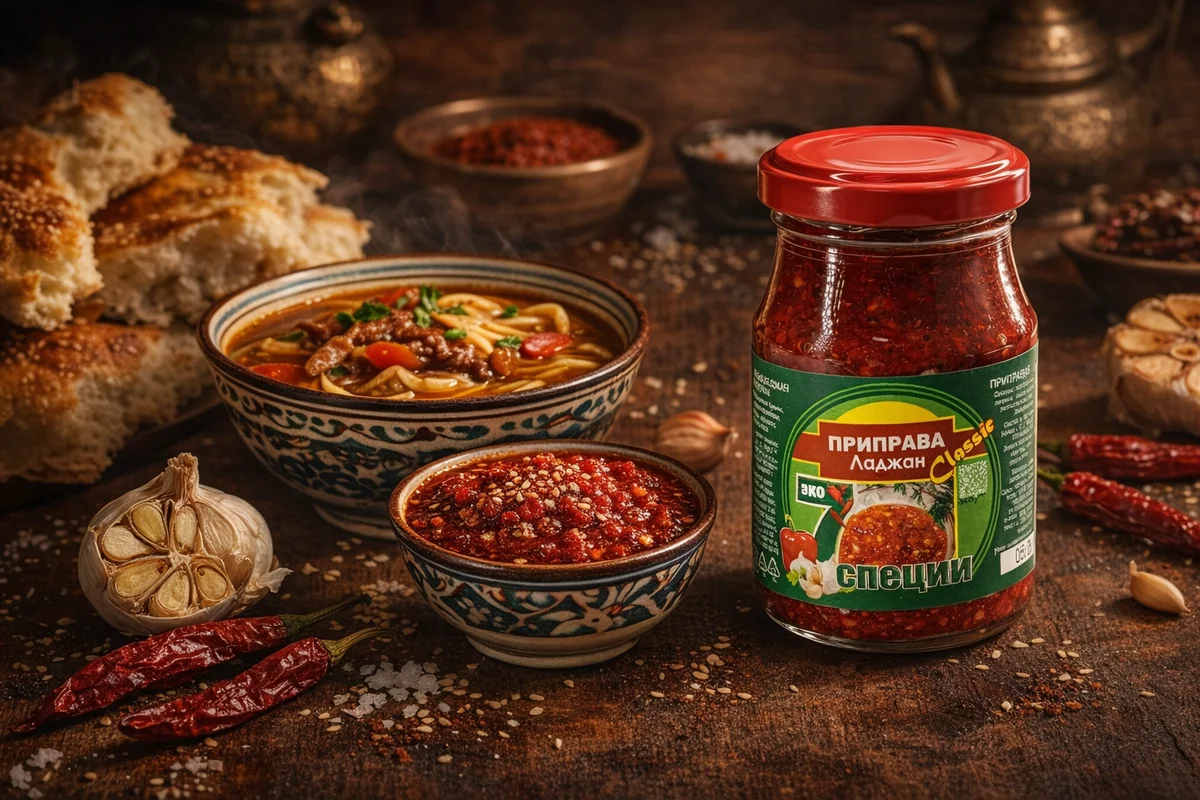
If you have been to a Uyghur restaurant in Almaty, you have probably seen a small bowl of bright red, oily paste on the table. That is ladzhan, a spicy condiment without which Central Asian cuisine is hard to imagine. It is added to lagman, manty and ashlyamfu, and served with shashlik and dumplings. In this article, we explain what ladzhan is, what it is made of and how the three types of Eco7 ladzhan differ from one another.
What Is Ladzhan
Ladzhan (also lazdzhan, laza, lazi) is a spicy condiment made from ground red pepper heated in very hot vegetable oil with garlic, sesame seeds and spices. It originated in Uyghur cuisine, but today ladzhan is common throughout Central Asia: in Kazakhstan, Kyrgyzstan and Uzbekistan.
The basic method: very hot oil is poured over dry ground pepper. The oil "activates" capsaicin (the substance responsible for the heat) and releases aromatic compounds from the pepper and spices. The result is a rich, fragrant, oily red paste.
Ladzhan is a condiment rather than a sauce. It is not poured over a dish but added in small amounts: a quarter of a teaspoon is enough to make a bowl of lagman noticeably hotter.
Where Ladzhan Comes From
The name goes back to the Chinese word 辣子 (lazi), meaning "hot pepper". From it, the word "laza" entered the languages of Central Asia: it is the name for hot red pepper and for a paste of it fried in oil (Komilova, 2023). The Russian magazine Vokrug Sveta calls the condiment for lagman "lazi, or lazdzhan" and describes it as pepper, tomatoes and garlic fried in vegetable oil.
Ladzhan is a condiment of Uyghur and Dungan cuisine. According to the 2021 census, about 290,000 Uyghurs live in Kazakhstan, about 113,000 of them in Almaty (Bureau of National Statistics of Kazakhstan). In Almaty, ladzhan is well known from Uyghur cafés, where it is served with lagman in a separate small bowl.
What Goes into Ladzhan and How It Is Made
Ladzhan is based on dried red pepper, vegetable oil and garlic; different recipes also add tomatoes, sesame seeds and spices. The principle is the same as for Chinese chili oil, which is oil infused with dried pepper (Yang et al., 2024): the oil is heated to a high temperature and poured over ground pepper (Li et al., 2025). The hot oil draws color, aroma and the pungent compounds known as capsaicinoids out of the pepper.
How hot is it? The heat depends above all on the pepper variety: in a study of chili oil, the capsaicinoid content of different samples varied about 40-fold (Yang et al., 2024). For reference, jalapeño measures 2,000–8,000 units on the Scoville scale and cayenne pepper 25,000–50,000 (University of Florida). That is why ladzhan can be either moderately hot or very hot — Eco7 makes three different types.
Three Types of Eco7 Ladzhan
Ladzhan Classic. The basic recipe: red pepper, vegetable oil, garlic and sesame seeds. Moderate heat and a rich peppery aroma. Suitable for everyday use — with soups, manty, dumplings and shashlik. If you are trying ladzhan for the first time, start with Classic.
Ladzhan Extra. Higher heat. More pepper, so it is hotter and more intense. For those who like it hot. Goes well with fatty dishes: plov, beshbarmak, kazy.
Ladzhan Uyghur. A Central Asian recipe with a distinctive blend of spices. A more complex, layered flavor than Classic. Good with dishes of Uyghur and Dungan cuisine: lagman, ashlyamfu, samsa.
All three types come in 110 g glass jars. A jar lasts a long time: you need 0.5–1 teaspoon per serving.
Which Dishes Pair with Ladzhan
Lagman. The classic pairing. Lagman without ladzhan is like borscht without sour cream. Add it straight to the bowl and stir it into the broth.
Manty and dumplings. Put a little ladzhan on the edge of the plate and dip each dumpling in it.
Shashlik and grilled food. Ladzhan Extra is a great companion for meat cooked over a fire.
Plov. A little ladzhan on top of hot plov enhances the flavor and adds a piquant touch.
Soups. Shorpa, sorpa, any meat broth — ladzhan opens up in hot liquid, releasing its aroma and heat.
Pizza and pasta. It may be unexpected, but ladzhan works great with Italian food — in place of Tabasco or chili flakes.
Fried eggs. Add a quarter of a spoon of ladzhan to your morning fried eggs, and an ordinary breakfast comes alive.
Ladzhan vs. Adjika vs. Sriracha
Ladzhan is often confused with other hot condiments, but they differ in texture, flavor and use:
Ladzhan is an oily paste based on pepper in very hot oil. Flavor: peppery and garlicky, with a sesame aroma. Texture: oily, grainy. Use: added to a finished dish.
Adjika is a spicy paste of fresh peppers, garlic and herbs (Georgian or Abkhazian cuisine). Flavor: fresher, herbal. Texture: paste-like, moist. Use: as a condiment and as a sauce in its own right.
Sriracha is a Thai hot sauce made from chili peppers, vinegar, garlic and sugar. Flavor: sweetish and hot, with a slight tang. Texture: liquid sauce. Use: poured over a dish.
Ladzhan is the most "oily" of the three. It contains no vinegar or sugar, so its flavor is cleaner and closer to that of the pepper itself. If you like Sriracha but want something more authentic and less sweet, try ladzhan.
| Ladzhan | Adjika | Sriracha | Harissa | |
|---|---|---|---|---|
| Origin | Uyghur cuisine | Abkhazia / Georgia | Thailand | Tunisia / Maghreb |
| Base | Oil + pepper + spices | Pepper + garlic + herbs | Chili + vinegar + garlic + sugar | Pepper + coriander + cumin |
| Consistency | Oily paste | Thick paste | Liquid sauce | Paste |
| Heat level | Medium–high | High | Medium | Medium–high |
| Use | Lagman, meat, plov | Meat, vegetables | Pho, rolls, any food | Couscous, tagines, meat |
How to Make Ladzhan at Home
Homemade ladzhan is made from three main ingredients: dried pepper, oil and garlic. Recipe for a small jar, about 200 ml:
- 4 tablespoons of crushed dried red pepper (flakes; without the seeds, the heat is milder);
- 150 ml of refined, odorless vegetable oil;
- 4–5 cloves of garlic;
- 1 teaspoon of sesame seeds — optional;
- ½ teaspoon of salt.
- Put the pepper, salt and sesame seeds in a heatproof glass or ceramic bowl. Finely chop the garlic.
- Heat the oil in a saucepan to about 150–190 °C: a pinch of pepper dropped into the oil should sizzle at once but not turn black. In a study of Chinese chili oil, tasters liked oil heated to this range best, while at 240 °C the pepper burned (Zhang et al., 2025).
- Pour the hot oil over the pepper in two or three batches, stirring each time: the pepper will sizzle and darken. If the oil is overheated, the pepper will burn and the ladzhan will turn bitter.
- Add the garlic to the still-hot mixture and stir.
- Let it cool and transfer it to a clean, dry jar with a lid.
An important note on storage. Garlic in oil that has not been acidified creates conditions in which the bacteria that cause botulism can multiply, and hot oil does not remove this risk. So keep homemade ladzhan with garlic only in the refrigerator and eat it within 4 days; if you need to keep it longer, freeze it in portions (CDC, NCHFP).
If you are short on time, there is ready-made Eco7 ladzhan in three types: Classic, Extra and Uyghur.
How to Store
Keep an opened jar of ladzhan in the refrigerator with the lid tightly closed, and go by the after-opening shelf life given on the label. Take the condiment out only with a clean, dry spoon — moisture and food crumbs make it spoil — and do not keep moving the jar between the fridge and a warm place: the temperature changes cause condensation to form inside (Consumer Council, Hong Kong).
Where to Buy Ladzhan in Almaty
Eco7 ladzhan comes in three types — Classic, Extra and Uyghur — in 110 g glass jars. All three are in the sauces and spices catalog.
- In stores. The products we supply are sold by retail chains and shops in Almaty and other regions — see the "Where to Buy" page for details.
- Wholesale. For shops, cafés and restaurants — supply terms are on the "Wholesale" page.
- To order or ask a question — message us on WhatsApp.
Besides ladzhan, Eco7 also makes other condiments: adjika, pepper sauce and four kinds of mustard (Dijon, French, Russian and Bavarian).
Frequently Asked Questions
What is ladzhan?
A spicy condiment of Uyghur and Dungan cuisine: dried red pepper with very hot oil poured over it, plus garlic and spices. It is added to finished dishes such as lagman, manty, soups and meat.
Which spelling is correct: ladzhan or lazdzhan?
There is no single spelling: the word came from Uyghur and Dungan, and Russian writes it in several ways. Transliterated into Latin script, the most common spellings are "ladzhan" and "lazdzhan", with "lazzhan", "landzhan" or "ladzzhan" seen less often. They are all spellings of the same word for the same condiment.
Is ladzhan spicy?
Yes. Eco7 Ladzhan Classic is moderately hot, Extra is the hottest of the three, and Uyghur stands out for its blend of spices and more complex flavor. Start with a quarter of a teaspoon per plate.
What do you eat ladzhan with?
With lagman, manty and dumplings, shashlik, plov and meat soups. It is also added to fried eggs, pizza and pasta instead of chili flakes.
How long does opened ladzhan keep?
Store-bought ladzhan keeps in the refrigerator, with the lid tightly closed, for as long as the label says; take it out with a dry, clean spoon. Keep homemade ladzhan with garlic in the refrigerator for no longer than 4 days, or freeze it.
Where can I buy ladzhan in Almaty?
All three types of Eco7 ladzhan are in the sauces and spices catalog on ecotrading.kz. The "Where to Buy" page shows which stores in Almaty sell our products; for wholesale, use the "Wholesale" page or WhatsApp.
Sources
- Capsaicin — StatPearls / National Library of Medicine, 2024
- Komilova M. "O‘zbek tiliga xitoy tilidan o‘zlashgan oziq-ovqat nomlari tahlili" — Oriens, 2023
- Knyazeva E. 'Stretched Pleasure: The History and Recipe of Lagman' — Vokrug Sveta, 2018
- 2021 National Population Census — Bureau of National Statistics of Kazakhstan
- Yang F. et al. Chili oil: capsaicinoids and quality — Molecules, 2024
- Li X. et al. Sichuan red oil processing — Foods, 2025
- Zhang F. et al. Oil temperature and quality of chili oil — China Oils and Fats, 2025
- Peppers by Scoville Units — University of Florida IFAS Extension
- Botulism Prevention — Centers for Disease Control and Prevention (CDC)
- Freezing Garlic in Oil — National Center for Home Food Preservation (NCHFP)
- Condiment storage — Consumer Council, Hong Kong, 2020