Drying is one of the oldest ways to keep fruits and berries for the winter. But not every drying method is equally gentle on vitamins. Some of the nutrients break down during drying, especially at high temperatures and during long drying with hot air (Calín-Sánchez et al., 2020). Vacuum drying runs at a lower temperature. In this article we explain how it works and how BioClub dried fruits differ from ordinary ones.
How Vacuum Drying Works
In conventional drying, hot air is blown over the fruit and the moisture gradually evaporates. The problem is that when heated, vitamin C, some of the B vitamins, enzymes and antioxidants break down. The color darkens and the taste changes.
Vacuum drying works differently. The product is placed in a chamber from which the air is pumped out. At low pressure, water evaporates at a much lower temperature. This removes the moisture while barely damaging the cell structure, the vitamins, the color and the flavor.
The result is a dried fruit that looks bright, has a rich taste and keeps most of the vitamins and minerals of the fresh product.
Drying Methods Compared
Conventional heat drying. Affordable and cheap. The color darkens and the taste becomes more caramel-like. The texture is often tough.
Vacuum drying. Runs at a lower temperature, so more vitamins are preserved than in conventional drying. The color stays bright and the taste close to fresh. The texture is crunchy or slightly chewy. Costs more than conventional drying.
Freeze-drying (lyophilization). The gentlest and the most expensive method. The product is frozen and the moisture is removed under vacuum. The dried fruits come out very light and crunchy but cost considerably more.
Vacuum drying is the best balance between quality and price. It keeps most of the beneficial properties, while the finished product costs considerably less than freeze-dried fruit.
Which Berries and Fruits BioClub Offers
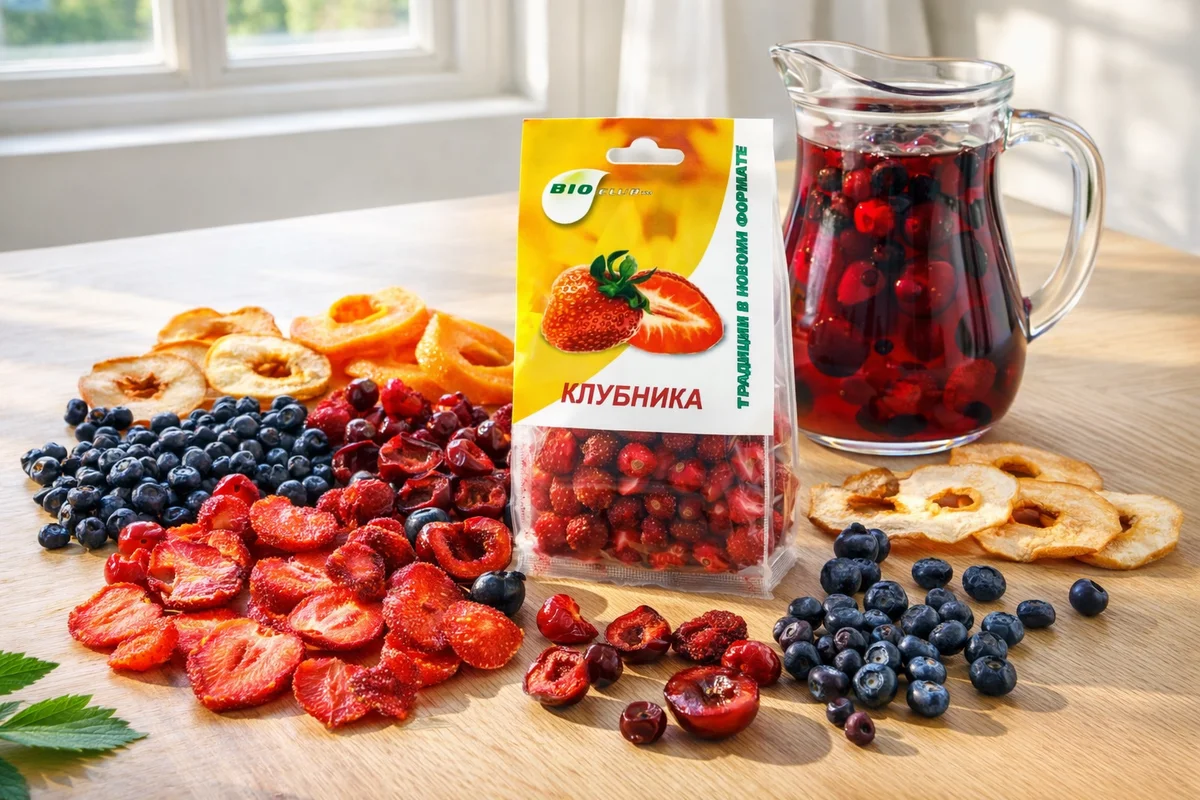
The BioClub range includes 13 kinds of dried berries and fruits, each with its own taste and composition:
- Strawberry — bright flavor, rich in vitamin C and contains manganese (USDA). A great snack and an addition to porridge.
- Raspberry — fragrant, rich in fiber, contains vitamin C and manganese (USDA). Dried raspberries are added to tea.
- Blueberry — rich in anthocyanins, plant pigments (Kalt et al., 2020).
- Cherry — sweet and sour, contains anthocyanins (Kelley et al., 2018).
- Cranberry — sweet and sour, contains vitamin C (USDA) and proanthocyanidins (Nemzer et al., 2022).
- Blackberry — contains vitamins C and K (USDA). Vitamin C supports the immune system, and vitamin K is needed for blood clotting (Carr, Maggini, 2017; Mladěnka et al., 2022).
- Black currant — one of the best sources of vitamin C among berries: raw black currants contain about 180 mg per 100 g (USDA).
- Rosehip — one of the richest fruits in vitamin C: raw rose hips contain about 8 times more than oranges (USDA FoodData Central; orange data). For tea and infusions, see how to brew rosehip.
- Hawthorn — contains flavonoids and procyanidins (Tamayo-Vives et al., 2025). Brewed like tea.
- Barberry — sweet and sour, added to plov and tea. Rich in vitamin C (Rahimi-Madiseh et al., 2017).
- Apricot — a source of potassium and beta-carotene (USDA). For compote and snacking.
- Prune — soft, pitted and rich in fiber (USDA).
- Apple — crunchy slices. A natural snack with no additives.
All BioClub dried fruits contain no sugar, preservatives or colorants. The 30–80 g packs are handy for a snack on the go.
Compote Mixes: What They Are and How to Make Them
Besides single berries, BioClub makes ready-made compote mixes — blends of dried fruits in one pack, each enough for 2.5–3 liters of drink. There are 8 mixes in the range: Fruit & Berry, Strawberry, Cherry, Plum, Black Currant and others.
A quick compote from a BioClub mix:
- Bring 2.5 liters of water to a boil.
- Pour the contents of the pack (80 g) into the boiling water.
- Turn down the heat and simmer for 3 minutes.
- Add 1–2 tablespoons of honey or sugar if you like.
- Take it off the heat and let it steep for 30 minutes.
- Done! Serve warm or chilled.
Dried berry compote is a natural alternative to store-bought drinks. It has no colorants, flavorings or preservatives — just berries and water.
How many berries to use per liter, how to make compote without sugar and five more recipes — in the article "Dried Berry and Fruit Compote: Ratios and Recipes".
Other Ways to Use Dried Fruits
A snack. A pack of dried berries is easy to take with you — to the office, on a walk, on a trip. 50 g of strawberries or blueberries is a healthy substitute for candy and cookies.
A porridge topping. Morning oatmeal with dried raspberries, blueberries or cherries is tastier and healthier than with jam.
Baking. Dried cherries, cranberries and prunes are great for cakes, muffins and cookies.
Tea. Rosehip, hawthorn and barberry can simply be steeped in boiling water right in the cup for a fragrant drink.
The full range of dried fruits and mixes is in our catalog.
Sources
- Calín-Sánchez Á. et al. Comparison of Traditional and Novel Drying Techniques and Its Effect on Quality of Fruits, Vegetables and Aromatic Herbs — Foods, 2020
- WHO Healthy Diet Fact Sheet
- U.S. Department of Agriculture. Strawberries, raw — FoodData Central, SR Legacy, FDC ID 167762, 2019
- U.S. Department of Agriculture. Raspberries, raw — FoodData Central, SR Legacy, FDC ID 167755, 2019
- Kalt W. et al. Recent Research on the Health Benefits of Blueberries and Their Anthocyanins — Advances in Nutrition, 2020
- Kelley D. S., Adkins Y., Laugero K. D. A Review of the Health Benefits of Cherries — Nutrients, 2018
- U.S. Department of Agriculture. Cranberries, raw — FoodData Central, SR Legacy, FDC ID 171722, 2019
- Nemzer B. V. et al. Cranberry: Chemical Composition, Antioxidant Activity and Impact on Human Health: Overview — Molecules, 2022
- U.S. Department of Agriculture. Blackberries, raw — FoodData Central, SR Legacy, FDC ID 173946, 2019
- Carr A. C., Maggini S. Vitamin C and Immune Function — Nutrients, 2017
- Mladěnka P. et al. Vitamin K – sources, physiological role, kinetics, deficiency, detection, therapeutic use, and toxicity — Nutrition Reviews, 2022
- U.S. Department of Agriculture. Currants, european black, raw — FoodData Central, SR Legacy, FDC ID 173963, 2019
- U.S. Department of Agriculture. Rose Hips, wild (Northern Plains Indians) — FoodData Central, SR Legacy, FDC ID 168998, 2019
- U.S. Department of Agriculture. Oranges, raw, all commercial varieties — FoodData Central, SR Legacy, FDC ID 169097, 2019
- Tamayo-Vives C. et al. Crataegus monogyna Jacq., Sorbus aria (L.) Crantz and Prunus spinosa L.: From Edible Fruits to Functional Ingredients: A Review — Foods, 2025
- Rahimi-Madiseh M. et al. Berberis vulgaris: specifications and traditional uses — Iranian Journal of Basic Medical Sciences, 2017
- U.S. Department of Agriculture. Apricots, dried, sulfured, uncooked — FoodData Central, SR Legacy, FDC ID 173941, 2019
- U.S. Department of Agriculture. Plums, dried (prunes), uncooked — FoodData Central, SR Legacy, FDC ID 168162, 2019