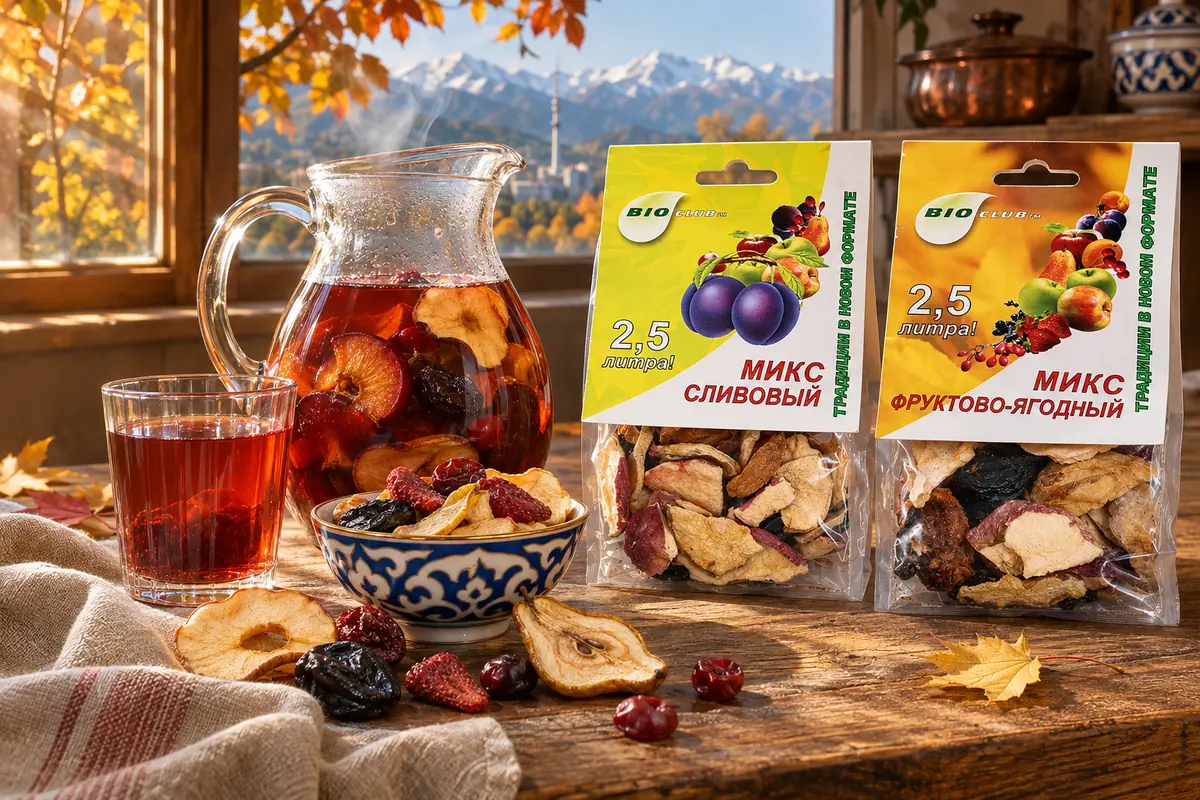
Rosehip infusion is a familiar autumn and winter drink: people brew it in a thermos, drink it instead of tea and add it to compotes. This article covers how to brew dried rosehip in a thermos and in a pot, how much to use and how long to steep it, how much vitamin C it really contains, what to pair it with and who should be careful with it.
How Much Vitamin C Is in Rose Hips
Rosehip is known for its vitamin C, and deservedly so. According to the U.S. Department of Agriculture, raw wild rose hips contain 426 mg of vitamin C per 100 g, while oranges contain 53 mg, which is about 8 times less (USDA FoodData Central; orange data). The figures depend heavily on the species and where the fruit was harvested: studies of different rosehip species have found from 839 to 1972 mg per 100 g of dry weight (Oargă et al., 2024).
Some of the vitamin is lost during drying: in an experiment in which rose hips were dried at 20, 35 and 68 °C, the fruits lost from 19 to 35% of their vitamin C (Gruszecki et al., 2024). Under the standard, dried rose hips sold in pharmacies must contain at least 0.2% ascorbic acid, which is 200 mg per 100 g (State Pharmacopoeia of Russia).
Not all of it ends up in your cup. In a laboratory experiment, 2 g of ground rosehip was brewed in 100 ml of water at 70–90 °C for 2 to 10 minutes, and the drink contained about 3 mg of vitamin C per 100 ml (İlyasoğlu, Arpa, 2017). How much of the vitamin you get depends largely on how you brew it — more on that below.
Besides vitamin C, rose hips contain carotenoids — lycopene and beta-carotene — and phenolic compounds (Goztepe et al., 2022). But rosehip infusion is a drink, not a medicine: it adds variety to your diet, but it does not replace treatment.
How to Prepare the Berries
Dried rosehip just needs a rinse in cool water. Whole berries can be brewed right away, but less vitamin C passes from them into the drink: in an experiment with frozen rose hips, about 20% of the vitamin passed into the infusion from whole fruits, and about 86% from cut ones (Yavru, Kadıoğlu, 1997). So it is better to cut the berries in half or lightly crush them with a rolling pin.
Keep one thing in mind: rose hips are lined inside with long, stiff hairs (State Pharmacopoeia of Russia) that can irritate the mouth and throat (PFAF). That is why an infusion of crushed berries must be strained through cheesecloth folded in several layers — preferably twice.
How to Brew Rosehip in a Thermos
- Warm up the thermos: fill it with boiling water for 10 minutes, then pour the water out.
- Add the rosehip: 1 tablespoon (about 10 g) per glass of water, or 5 tablespoons for a one-liter thermos.
- Pour in boiling water, close the lid and leave for about 6 hours.
- Strain and drink warm.
This is the method that gave the most vitamin C in an experiment by pharmacists who compared six ways of preparing rosehip: boiling water, a pre-warmed thermos, 6 hours. Without pre-warming the thermos, there was less of the vitamin, but still more than with any method that did not use a thermos. There is no point in steeping it longer than 6 hours: after 12 hours, there was less vitamin C in the infusion (Sobin et al., 2022).
How to Brew Rosehip in a Pot
- Put 5 tablespoons of berries per liter of water into an enamel pot and pour hot water over them.
- Bring to a boil and simmer over low heat, covered, for 5–10 minutes.
- Take off the heat and let it steep, covered, until it cools — about 45 minutes.
- Strain.
There is no need to boil rosehip for long. In the same experiment, a decoction heated for 30 minutes at 97 °C contained less than a quarter of the vitamin C found in a similar infusion heated for 15 minutes (Sobin et al., 2022).
| Thermos | Pot | |
|---|---|---|
| Berries per 1 liter | 5 tbsp (about 50 g) | 5 tbsp (about 50 g) |
| Water | Boiling, thermos pre-warmed | Hot, then 5–10 minutes over low heat |
| Steeping time | About 6 hours | About 45 minutes, until it cools |
| Vitamin C | Highest in the experiment | Lower; long heating reduces it several-fold |
How Much to Drink and How
Rosehip infusion is drunk warm or chilled, like tea. The leaflet for rose hips sold in pharmacies advises adults to drink half a glass of the infusion 2 times a day (patient information leaflet). The same leaflet recommends storing the prepared infusion in a cool place for no more than 2 days, but it is better to brew a fresh one: within a day, the vitamin C content of the drink drops noticeably (Chrubasik et al., 2008).
The infusion is acidic: in a laboratory experiment, rosehip tea caused erosion of tooth enamel samples (Niemeyer et al., 2021). This was an experiment in a test tube, not in people, but rinsing your mouth with water after a cup of the infusion won't hurt.
What to Pair Rosehip With
Hawthorn. It is brewed together with rosehip in the same proportions; BioClub hawthorn is sold in 80 g packs, just like rosehip. If you take heart medications, consult your doctor first: hawthorn may interact with them (NCCIH).
Apples and other dried fruits. A handful of dried apples softens the tartness of the infusion, and rosehip gives dried fruit compote a brighter flavor — recipes are in the article "Dried Berry and Fruit Compote".
Honey and lemon. Add honey to taste to the warm infusion, and a slice of lemon straight into the cup. Do not give honey to children under one year old (CDC).
Black currant, barberry, cranberry. BioClub dried berries add aroma and a slight tartness — you can brew them together with rosehip.
Contraindications and Cautions
The leaflet for rose hips sold in pharmacies lists two contraindications: hypersensitivity to rosehip and gallstone disease; allergic reactions are listed as a side effect (patient information leaflet). Reference guides on herbal remedies add further cautions (RxList; WebMD):
- kidney stones and kidney disease — large amounts of vitamin C increase the risk of stones;
- excess iron in the body (hemochromatosis) and some blood disorders — vitamin C enhances iron absorption;
- taking medications, especially blood thinners — interactions between rosehip and medications are poorly studied;
- a sensitive stomach — heartburn, nausea and bowel upset are possible.
If you are pregnant or breastfeeding, do not go beyond normal food amounts: there is no data on the safety of large doses (RxList). And if you take medications long-term, it is best to ask your doctor about drinking the infusion regularly.
How BioClub Vacuum Drying Differs from Conventional Drying
In conventional drying, hot air is blown over the fruit. BioClub dried fruits, including rosehip, are dried in a vacuum: at low pressure, water evaporates at a lower temperature — more on this in the article "Vacuum-Dried Fruits".
Drying temperature matters for vitamin C: in an experiment with rose hips, drying at 68 °C took away about a third of the vitamin, and drying at 35 °C less than a fifth (Gruszecki et al., 2024). And in a comparison of different ways of drying rose hips, vacuum drying preserved more bioactive compounds than hot-air drying (Goztepe et al., 2022).
Where to Buy Dried Rosehip in Almaty
BioClub rosehip is sold in 80 g packs — find it in the dried fruit catalog, which also has hawthorn, barberry, black currant and compote mixes. The "Where to Buy" page shows which stores in Almaty and the regions to look in for our products. We supply wholesale with delivery across Kazakhstan — message us on WhatsApp.
Frequently Asked Questions
How much rosehip should I use per liter of water?
About 5 tablespoons (50 g) per liter — a tablespoon per glass of water. It is better to cut or lightly crush the berries and to strain the finished infusion.
How long should rosehip steep in a thermos?
About 6 hours in a pre-warmed thermos. There is no need to steep it longer: in the pharmacists' experiment, there was less vitamin C in the infusion after 12 hours than after 6.
Can you pour boiling water over rosehip?
Yes. In the pharmacists' experiment, it was boiling water in a pre-warmed thermos that gave the most vitamin C. What harms the vitamin is prolonged heating: after 30 minutes of heating, the drink had less than a quarter of the vitamin C it had after 15 minutes.
Do you need to strain rosehip infusion?
Yes, especially if the berries are crushed: inside the fruits there are stiff hairs that can irritate the mouth and throat. Strain it through several layers of cheesecloth.
How much rosehip infusion can you drink a day?
The leaflet for rose hips sold in pharmacies advises adults to drink half a glass of the infusion 2 times a day. If you have kidney stones or gallstone disease, take medications, or are pregnant or breastfeeding, consult your doctor.
Sources
- U.S. Department of Agriculture. Rose Hips, wild (Northern Plains Indians) — FoodData Central, SR Legacy, FDC ID 168998, 2019
- U.S. Department of Agriculture. Oranges, raw, all commercial varieties — FoodData Central, SR Legacy, FDC ID 169097, 2019
- Oargă D. P. et al. Unveiling the mechanisms for the development of rosehip-based dermatological products: an updated review — Frontiers in Pharmacology, 2024
- Gruszecki R. et al. Effect of drying temperature on the bioactive compounds content of rose hips (Rosa canina L.) — Acta Scientiarum Polonorum Hortorum Cultus, 2024
- FS.2.5.0106 "Rose hips" — State Pharmacopoeia of the Russian Federation, 15th edition, 2024
- İlyasoğlu H., Arpa T. E. Effect of brewing conditions on antioxidant properties of rosehip tea beverage: study by response surface methodology — Journal of Food Science and Technology, 2017
- Goztepe B. et al. Drying kinetics, total bioactive compounds, antioxidant activity, phenolic profile, lycopene and β-carotene content and color quality of Rosehip dehydrated by different methods — LWT, 2022
- Yavru İ., Kadıoğlu A. The Effects of Infusion Temperatures and Times on Vitamin C Content Infused From Fruits of Dog Rose (Rosa Canina L.) — Turkish Journal of Botany, 1997
- Rosa canina — Plants For A Future (PFAF) Plant Database
- Sobin F. V. et al. Study of the effect of the technological regime of preparing an aqueous extract of rose hips (Rosae fructus) on ascorbic acid content — Drug Development & Registration, 2022
- Rose hips (LSR-002623/09, Ivan-Chai JSC) — patient information leaflet, MEDI RU
- Chrubasik C. et al. A Systematic Review on the Rosa canina Effect and Efficacy Profiles — Phytotherapy Research, 2008
- Niemeyer S. H. et al. Salivary pellicle modification with polyphenol-rich teas and natural extracts to improve protection against dental erosion — Journal of Dentistry, 2021
- Hawthorn: Usefulness and Safety — National Center for Complementary and Integrative Health (NCCIH), 2025
- Botulism Prevention — Centers for Disease Control and Prevention (CDC)
- Rose Hip: Health Benefits, Side Effects, Uses, Dose & Precautions — RxList
- Rose Hip — Uses, Side Effects, and More — WebMD