Store shelves are lined with dozens of juice varieties — in cartons, bottles, and boxes. But not all of them are equally natural. Some are made from fresh fruits, while others come from powdered concentrate diluted with water. In this article, we'll explore what direct-pressed juice is, how it differs from reconstituted juice and nectar, and what to look for when choosing.
Three Types of 'Juice' on the Shelf
Direct-pressed juice — juice obtained directly from fresh fruits or vegetables through mechanical pressing. Not diluted with water, no added sugar, flavorings, or concentrate. Fruit content — 100%.
Reconstituted juice — the most common type. Produced from concentrate: juice is pressed from fruits, water is evaporated to make concentrate, then it's shipped to a factory, diluted with water, and bottled. Technically also '100% juice,' but taste and nutritional value differ.
Nectar — a mixture of juice (or purée) with water and sugar. Juice content 25–50%.
| Direct-pressed | Reconstituted | Nectar | |
|---|---|---|---|
| Production method | Pressed from fresh fruit | Concentrate + water | Puree + water + sugar |
| Juice content | 100% | 100% (reconstituted) | 25–50% |
| Vitamins | Maximally preserved | Partially lost | Minimal |
| Sugar | Natural only | Sometimes added | Added |
| Shelf life | 6–12 months | Up to 18 months | Up to 12 months |
| Price | Higher | Medium | Lower |
How to Read the Label
Look for 'direct-pressed juice.' It should say exactly that — not just 'juice' or 'natural juice.'
Ingredients. Direct-pressed juice should have only one ingredient — juice. If water, sugar, concentrate, or citric acid are listed, it's reconstituted or nectar.
Country of origin. Good producers indicate where the fruits come from.
Shelf life. Direct-pressed juice typically keeps for less time — a few months to a year.
Bag-in-Box Format: What It Is and Why It's Better
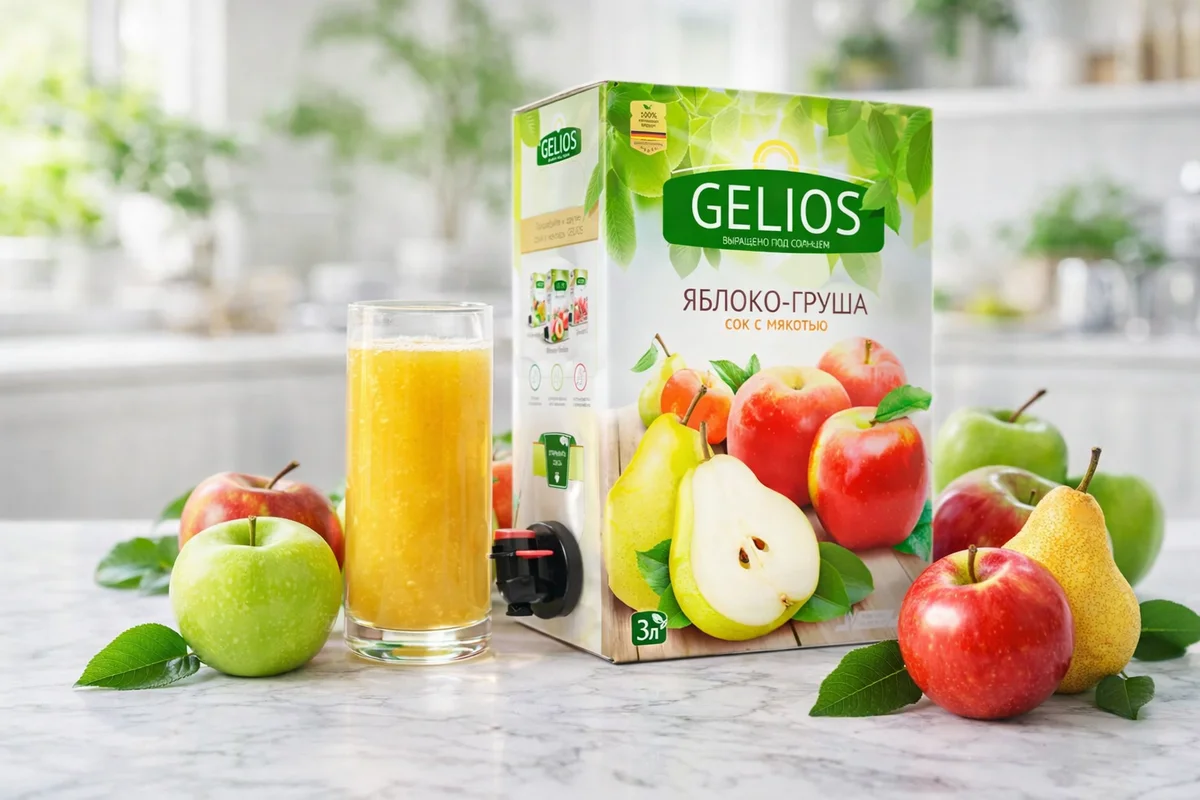
Bag-in-Box is a packaging format where juice is stored in a sealed bag with a tap inside a cardboard box. Volume is usually 3, 5, or 10 liters.
- Vacuum storage. As you pour, the bag collapses — no air gets in, preventing oxidation. Keeps for 3–4 weeks after opening.
- Economy. Per-liter cost in Bag-in-Box is lower than bottles or cartons.
- Convenience. The tap allows precise pouring; the box stands steadily in the fridge.
- Eco-friendly. Less plastic and cardboard per liter of product.
GELIOS juices come in the 3-liter Bag-in-Box format — optimal for families.
Who Benefits from Direct-Pressed Juice
For home and family. One 3-liter Bag-in-Box replaces 3–4 small cartons and costs less. Kids immediately notice the taste difference.
For restaurants, cafés, and hotels (HoReCa). The tap allows quick, clean pouring; large volumes reduce costs. GELIOS juices are perfect for breakfast service, bar drinks, and cooking.
For health-conscious consumers. No added sugar, fewer calories than nectars, better vitamin retention.
How Long Does Opened Juice Last
- Bag-in-Box — up to 3–4 weeks after opening;
- Glass bottle — 3–5 days;
- Carton — 2–3 days.
Summary: How to Choose Good Juice
- Look for the label 'direct-pressed juice.'
- Check ingredients — only juice, no water or concentrate.
- Note the country of origin.
- Bag-in-Box format offers the best value for money.
- Short shelf life is a sign of natural quality.
Natural juice is one of the simplest ways to get vitamins and enjoy authentic fruit flavor.