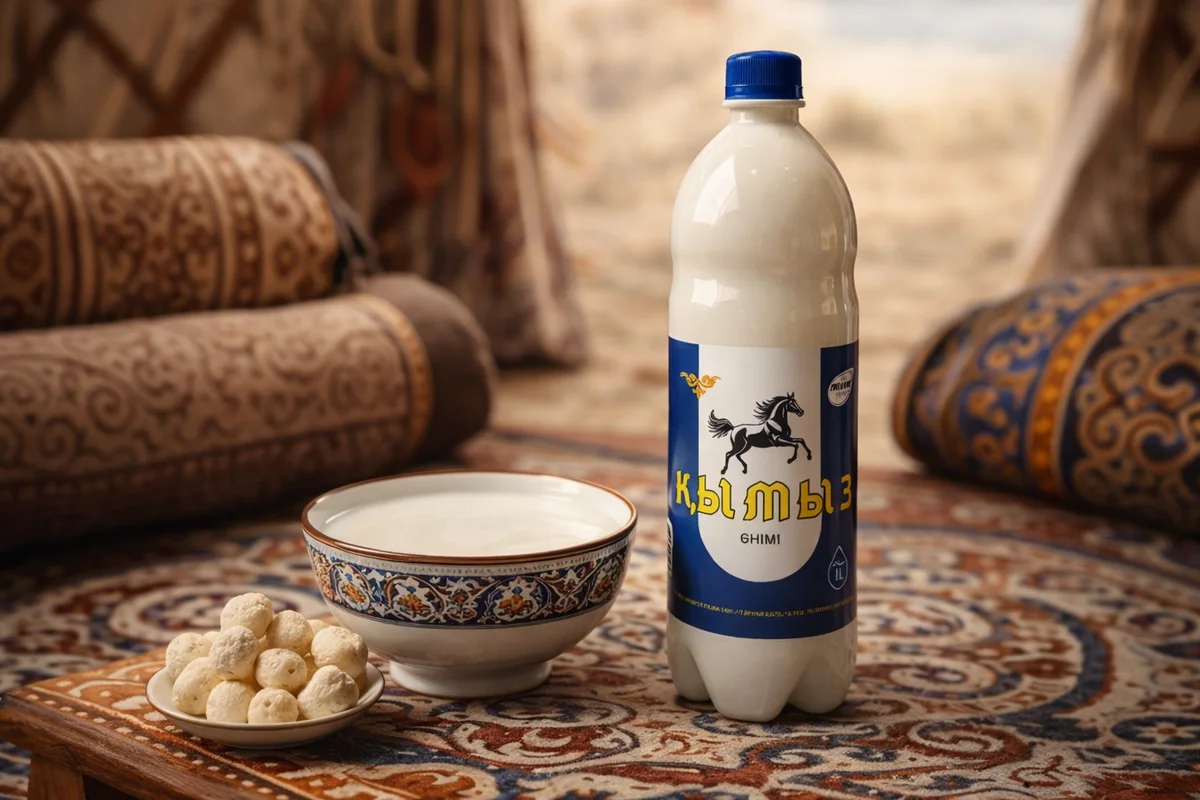
Kumys (also spelled koumiss) is one of the oldest fermented milk drinks: traces of mare's milk processing on ancient pottery from northern Kazakhstan have been dated to around 3500 BC (Martuzzi et al., 2024). This article covers what kumys is, what it is made of and how, what it contains and what research says about its benefits. We also explain honestly how kumys differs from the kumys product made by BioClub.
What Is Kumys
Kumys is a fermented milk drink made from mare's milk through mixed fermentation. First, lactic acid bacteria turn milk sugar into lactic acid, and then yeasts ferment the remaining sugar into alcohol and carbon dioxide (Martuzzi et al., 2024). That is why kumys has a slightly sour taste, a light fizz and a low alcohol content. The main role in fermentation is usually played by the bacterium Lactobacillus helveticus and the yeasts Saccharomyces cerevisiae and Kluyveromyces marxianus. Even today, Kazakhstan produces more kumys than any other country in the world.
The longer kumys ferments, the sourer and stronger it becomes. The Russian tradition distinguishes weak kumys at 0.7–1% alcohol, medium at 1–1.75% and strong at 1.75–2.5% (Martuzzi et al., 2024).
What Kumys Is Made Of and How It Is Made
Whose milk. Real kumys is made from mare's milk. It is very different from cow's milk: it contains less protein (2.1–2.7% versus 3.5%) and fat (1.0–1.5% versus 3.6%), but more milk sugar — 6–7% versus 4.6% (Shokrollahi et al., 2025). Mare's milk has much less casein: about 40% of its protein is whey protein (Xue et al., 2023), which is why it cannot be made into cheese (Martuzzi et al., 2024).
How it is prepared. Traditionally, fresh milk is poured into a wooden tub or a leather bag holding kumys left over from the previous batch; this leftover kumys serves as the starter culture. The milk is stirred vigorously for a long time with a wooden stirrer and left to ferment at room temperature for 1–3 days; kumys made this way keeps for 3–5 days (Xue et al., 2023). In industrial production, kumys ferments for several hours at 26–28 °C and is then cooled to 4–6 °C (Afzaal et al., 2021).
Why kumys is seasonal. Fresh mare's milk is a rare product: a mare is milked 4–6 times a day, yielding about one liter each time, and the milking season lasts from May to September. That is why real kumys made from fresh milk is available mainly in summer and near horse farms.
Composition and Calories
The composition of kumys depends on the milk, the starter culture and the fermentation time. Here are approximate figures from a review of studies (Afzaal et al., 2021):
| Per 100 g of kumys | Amount |
|---|---|
| Protein | 1.7–1.9 g |
| Fat | 0.6–1.3 g |
| Milk sugar (lactose) | 3.5–4.3 g |
| Lactic acid | 0.7–1.8 g |
| Alcohol | 0.6–2.5% |
We were unable to find a calorie figure for kumys made from mare's milk in reference books. Calculated from the composition in the table, it comes to roughly 30–55 kcal per 100 g, depending on its strength and fat content. For a specific drink, the exact figure is given on the label.
Kumys also contains vitamin C: according to a review, 1.8–5.8 mg per 100 g (Xue et al., 2023). That is not much: mare's milk has more vitamin C than cow's milk (Shokrollahi et al., 2025), but kumys can hardly be called a record holder.
Benefits of Kumys
Live microorganisms. Kumys usually contains 10⁸–10⁹ lactic acid bacteria and 10⁶–10⁷ yeasts per milliliter (Shokrollahi et al., 2025). Strains are isolated from kumys and then studied as probiotics. For example, a double-blind, placebo-controlled study was carried out with the strain Lactobacillus casei Zhang: 40 adults took it for 12 months, and the composition of their gut microbiota remained more stable (He et al., 2020). But note: this was a study of the strain in capsules, not of kumys itself.
Studies of kumys itself are still small. In one of them, 13 people with elevated blood lipids drank 750 g of kumys a day for 60 days; their level of HDL ("good") cholesterol rose and the composition of their gut microbiota changed (Hou et al., 2019). This is a small study without a placebo control, so it is too early to draw conclusions from it.
What reviews say. The authors of reviews agree: kumys contains many interesting substances — live cultures, protein-derived peptides, vitamins — but there are few clinical studies that would prove its benefits, and there are no randomized placebo-controlled trials (Shokrollahi et al., 2025; Martuzzi et al., 2024). So kumys is a tasty traditional drink with live cultures, not a medicine.
Kumys and Kumys Product: What's the Difference
The difference is set by a technical regulation of the Eurasian Economic Union: Customs Union Technical Regulation TR CU 033/2013 "On the Safety of Milk and Dairy Products". It defines kumys as a fermented milk product made by mixed fermentation of mare's milk with Bulgarian and acidophilus lactobacilli and yeast. A kumys product, by contrast, is made using the kumys process, but from cow's milk (TR CU 033/2013).
The BioClub kumys product is made from two types of freeze-dried (powdered) milk: mare's and cow's. Freeze-drying is a drying method in which the milk is first frozen and then its moisture is removed under vacuum; this way, dried mare's milk keeps for a long time, and the drink can be produced all year round, not just during the milking season.
Cow's milk softens the taste and makes the drink more familiar, while mare's milk gives it that distinctive "kumys" tang. The mixture is fermented with a kumys starter culture containing lactic acid bacteria and yeast, and it undergoes the same dual fermentation as kumys — lactic acid and alcoholic. But in composition it is no longer kumys made from mare's milk, which is why the label honestly says "kumys product".
Kumys, Kefir and Ayran
Kumys and the kumys product are often compared to kefir. The difference lies in the starter culture and the fermentation: kefir is fermented with kefir grains and undergoes mainly lactic acid fermentation, whereas kumys and the kumys product undergo dual fermentation, which gives them light carbonation and a more complex flavor. Kefir is thicker and denser, while kumys is lighter and refreshing.
| Kumys | Kefir | Ayran | |
|---|---|---|---|
| Base | Mare's milk | Cow's milk | Cow's milk |
| Fermentation type | Lactic acid + alcoholic | Mainly lactic acid | Lactic acid |
| Taste | Slightly sour, fizzy | Sour, thick | Slightly salty, thin |
| Origin | Central Asia | Caucasus | Turkic peoples |
A Bit of History: From Herodotus to Kumys-Cure Sanatoriums
Kumys was first mentioned by Herodotus in the 5th century BC, in his description of the Scythians. In Kazakhstan and Kyrgyzstan, kumys has always been part of everyday culture, and the start of the mare milking season is cause for celebration. In Mongolian tradition, the technique of making kumys in a leather bag is included in UNESCO's Intangible Cultural Heritage list.
In 1858, Dr. Nestor Postnikov opened Russia's first kumys-cure establishment near Samara — a sanatorium for tuberculosis patients (Alabin Museum, Samara). Kumys-cure sanatoriums quickly became popular: a course of kumys was combined with rest and steppe air, and doctors of the time noted that kumys increased the appetite of emaciated patients. Today, tuberculosis is treated with antibiotics, and at sanatoriums in Kazakhstan, Kyrgyzstan and Bashkortostan, kumys is part of the diet and relaxation.
How to Drink Kumys
- Drink it chilled: kumys is traditionally served cold, and the finished drink is stored at 4–6 °C (Afzaal et al., 2021).
- If you are drinking kumys for the first time, start with small portions. In sanatorium practice, people started with 50–100 ml of kumys at a time; there is no scientifically established recommended amount (Shokrollahi et al., 2025).
- Without refrigeration, homemade kumys keeps for only 3–5 days — buy it from places that keep an eye on quality.
- Store the BioClub kumys product in the refrigerator and drink it within its shelf life.
Contraindications
You should avoid kumys and the kumys product, or drink them only after consulting a doctor, if any of the following applies to you:
- pregnancy or a ban on alcohol. Kumys contains 0.6–2.5% alcohol (Afzaal et al., 2021), and no safe amount of alcohol during pregnancy has been established (CDC). The kumys product has less alcohol — up to 1–1.5% — but it still contains some;
- lactose intolerance. Fermentation reduces the amount of lactose, but up to 4.5% still remains in finished kumys (Afzaal et al., 2021);
- allergy to milk protein. People can be allergic to mare's milk too: some children with cow's milk allergy also reacted to mare's milk (Businco et al., 2000);
- a flare-up of stomach or intestinal disease — gastritis, ulcers and others.
Where to Buy Kumys in Almaty
Kumys made from fresh mare's milk is available mostly in summer, during the milking season. All year round in Almaty, you can buy the BioClub kumys product in two varieties:
Classic. Traditional kumys taste — sour-sweet, with light carbonation and a refreshing aftertaste.
Honey. Softer and sweeter thanks to natural honey. Suitable for those new to the taste of kumys or who find the classic tanginess too pronounced.
Both varieties come in a 1-liter bottle. We supply shops, cafés and restaurants wholesale, with delivery across Kazakhstan — the terms are on the "Wholesale" page or available via WhatsApp; the "Where to Buy" page shows which stores to look in for our products.
Sources
- Martuzzi F. et al. Fermented Mare Milk and Its Microorganisms for Human Consumption and Health — Foods, 2024
- Xue et al. Nutritional ingredients and prevention of chronic diseases by fermented koumiss: a comprehensive review — Frontiers in Nutrition, 2023
- Afzaal M. et al. Nutritional and ethnomedicinal scenario of koumiss: A concurrent review — Food Science & Nutrition, 2021
- Shokrollahi B. et al. Koumiss (Fermented Mare's Milk) as a Functional Food: Bioactive Proteins, Peptides, and Future Perspectives — Foods, 2025
- He Q. et al. Long-term administration of Lactobacillus casei Zhang stabilized gut microbiota of adults — Journal of Functional Foods, 2020
- Hou Q. et al. Koumiss consumption modulates gut microbiota, increases plasma high density cholesterol — Journal of Functional Foods, 2019
- TR CU 033/2013 "On the Safety of Milk and Dairy Products" — Adilet legal information system
- Businco L. et al. Allergenicity of mare's milk in children with cow's milk allergy — Journal of Allergy and Clinical Immunology, 2000
- About Alcohol Use During Pregnancy — Centers for Disease Control and Prevention (CDC)
- The Pride and Glory of Samara: N. V. Postnikov — Alabin Samara Regional Museum of History and Local Lore, 2013
- Traditional Technique of Making Airag — UNESCO Intangible Cultural Heritage, 2019